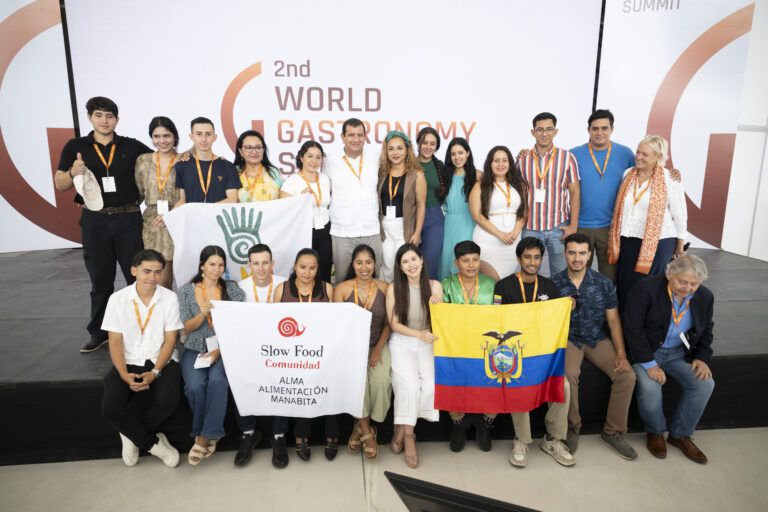
As part of the commitment by IGCAT and Manabí (2026 World Region of Gastronomy) to empower youth through gastronomy, several youth representatives working within the local food system were invited to participate in the 2nd World Gastronomy Summit.
These young voices, including and representing traditional food experts, fishers, farmers, livestock keepers, aquaculturists, foragers, Indigenous individuals, beekeepers, environmentalists, communicators, activists, professionals, and other youth leaders, are part of the Slow Food Alimentación Manabita (ALMA) volunteer group. This organization works to create good, clean, and fair food systems within the “food landscapes” of the Coastal mountain range and other areas along Ecuador’s Pacific coast.
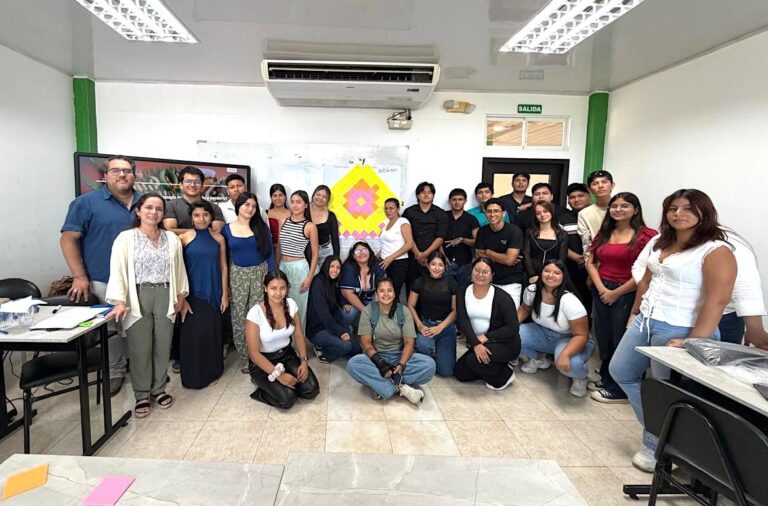
Brought together by Dr. Luis Andrade Alcívar, IGCAT expert and professor at the Escuela Superior Politécnica Agropecuaria de Manabí Manuel Félix López (ESPAM MFL), this remarkable group of about 20 youth, hailing from diverse towns, ethnic backgrounds, and geographic locations, offered a first-hand perspective on the challenges faced by rural Ecuadorian youth and, more importantly, on the solutions they are pursuing.
The young members of ALMA played a prominent role in the summit, making significant contributions throughout the event. Four members of the group, in particular, took the floor at the Summit:
Stefany Viteri Zambrano, an environmental activist, emphasized that food sovereignty begins in the soil. She noted that soil saturated with agrochemicals and genetically modified seeds cannot guarantee food for future generations, nor can it support good health. Consequently, she called for the enforcement of regulations and policies that uphold these principles—underscoring the vital need to recognize that if we fail to care for our soil and our native or heirloom seeds, we are failing to protect our culture and our ancestral culinary heritage.
Evin Lenin Añapa San Nicolás, a member of the Chachi Indigenous nation, spoke about the importance of representation for Indigenous peoples and ancestral communities living along the Ecuadorian Pacific coast. He also addressed the significance of ancestral gastronomy and the need to conserve the Pacific’s tropical rainforests, along with their biodiversity and freshwater resources.
Luis Ángel Paladines, founder of Cholos por el Mar, an organization that develops sustainable solutions to improve fishing practices, spoke on the need for greater environmental protection. He highlighted the importance of empowering small-scale fishing communities along the Manabí coast, while also raising awareness among chefs and consumers regarding the origins of the ingredients and food they use and eat.
Lastly, Michael Loor Palma, leader of the “Youth of Planet Earth” (Jóvenes del Planeta Tierra) network, pointed to the risks facing the gastronomy of Manabí: risks that extend beyond the kitchen to the very soil, water, and sea that sustain it. He spoke up on behalf of all the young people who no longer find the conditions necessary to remain in their communities and engage in sustainable production.
The 2nd World Gastronomy Summit was organized by the International Institute of Gastronomy, Culture, Arts and Tourism (IGCAT) and hosted by Manabí, World Region of Gastronomy 2026, with the support of the Manabí Provincial Government and the Universidad Laica Eloy Alfaro de Manabí (ULEAM).
At the end of the summit, they all called out in unison: Without young people and without a healthy planet, there is no food.